Jane Amendolara, Sr. Public Relations, Social Media, & Influencer Marketing Manager
There’s no secret sauce to brand success, but there was a time when polished content was the gold standard. Perfectly staged shots, 100% branded messaging, and scripted lines were how brands proved they were “serious.” Scroll through a Gen Z social feed today, though, and that level of polish often reads as stiff, distant, or … try-hard.
It’s not a sudden change. Social-first platforms have steadily nudged audience expectations toward a more unpolished, authentic style. While polish still has a time and place across the broader marketing mix, what was quietly emerging is now unmistakable in 2026: on social, relatability beats perfection every time.
Welcome to the era of the unpolished brand, where scrappy is the new serious.
Gen Z grew up online. They know what “real” content looks like because they make it themselves in minutes. They can spot a scripted or overproduced video in half a second. It’s not about production quality; it’s about authenticity. Overly polished content can make a brand feel like it’s managing perception rather than participating in culture. And participation? That’s what Gen Z actually values.
TikTok didn’t just change the look of content. Over the last several years, it’s changed the feel of it. Brands aren’t just competing with other brands anymore; they’re competing with a five-second meme, a chaotic storytime, or a random relatable comment that somehow lands perfectly. The algorithm rewards resonance, relatability, and timing. Not polish.
All of this means it’s time to rethink the brand book. Social-first brands need a new layer of guardrails that let teams move fast, lean into humor, respond in real time, and flex with trends. It’s not chaos. It’s strategic looseness, where the post is only the start. That’s because real engagement happens when a brand participates by joking along, acknowledging feedback, or even using the comment section as creative inspiration for future content. Huge brands like Dunkin’, for example, do this all the time, by sharing memes and posts that look like a five-year-old could have created them on an iPad. That’s how brands become relatable; they lean into the joke to build a real connection.
Scrappy content doesn’t mean you’re being lazy. Done right, it signals confidence: “We get the platform. We trust our team. We’re here to participate, take risks, and show up in unexpected ways.” When a brand intentionally lets go of perfection, the payoff isn’t just likes or shares. It’s cultural relevance.
Is Your Dashboard Reporting Growth or Just Noise?
Jen Hansen, Director of Analytics
Most CMOs are making million-dollar decisions based on fiction.
If your GA4 is showing “Unassigned” traffic, sampled data, or a disconnect between ROAS and bottom-line revenue, you don’t have a marketing problem—you have a data architecture problem.
The Reality: Your Tracking Is Leaking Revenue
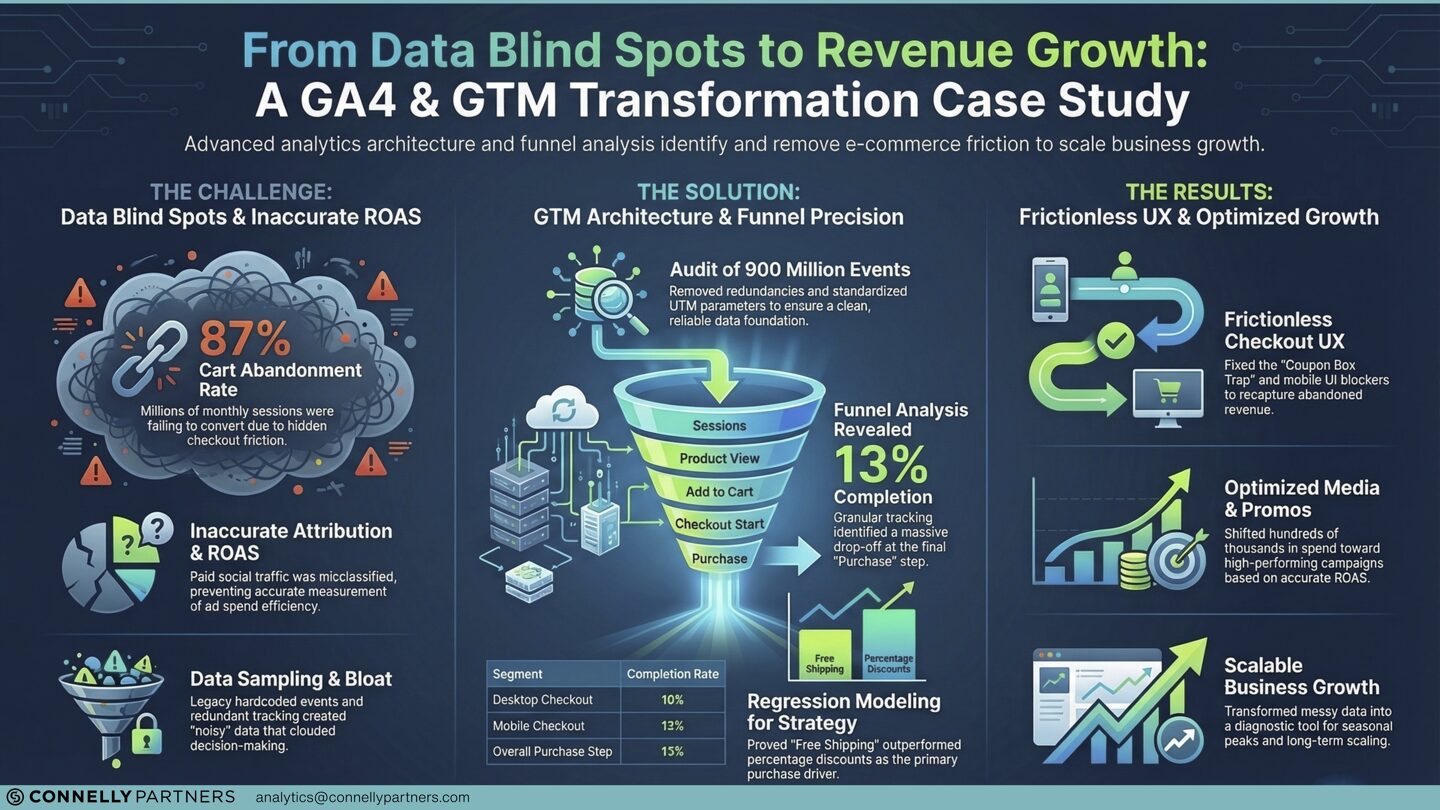
The shift to GA4 left most brands with a “Frankenstein” setup: bloated Google Tag Manager (GTM) containers, duplicate triggers, and broken attribution paths. This isn’t just “messy data”—it’s a blind spot that hides where your customers are actually dropping off.
We recently audited a premier retailer with 900 million annual events. Their data was so “noisy” they couldn’t see the truth: their final purchase step had a staggering 87% abandonment rate.
The Diagnostic Audit
You wouldn’t greenlight a $500k media spend based on a “hunch.” Why rely on a tracking setup you haven’t verified?
Our Analytics Audit is designed to transform raw data into Actionable Intelligence. We don’t just look for broken tags; we perform deep behavioral analysis to find the “Why” behind the “What”:
The Promo Code Trap: We discovered that an open coupon box was “inviting” users to leave the checkout to find discounts, killing conversion.
Mobile Friction: We identified unclickable UI elements on mobile—where 70% of their traffic lived—that were invisible in standard reports.
Strategy Shifts: Our regression modeling proved that “Free Shipping” drove more revenue than category discounts, allowing the brand to pivot their entire promotional calendar.
Stop Guessing. Start Scaling.
Once we sanitized the data stream and stabilized the tracking architecture, the results were immediate. We didn’t just “fix the tracking”; we gave the brand a roadmap to recapture lost revenue and scale media spend with 100% confidence in their ROAS.
Your data is either your greatest asset or your biggest liability. Before you spend another dollar on ads, let’s ensure you can actually track the return. Interested in booking a Custom Data Health Audit? Send us a note.
More Than A Moment: Designing the Gorton’s Shrimp and Cocktail Experience at SXSW 2025
There’s a specific feeling you get when a brand experience is done right. It feels less like marketing and more like discovery.
At Connelly Partners, we know that moving feet to purchase requires moving souls first. Modern consumers don’t fall in love with brands because they are told to. They fall in love because of how a brand made them feel in a moment: seen, welcomed, surprised, connected.
So when we were tasked with the challenge to bring Gorton’s Seafood to a younger audience in a way that felt authentic and modern, we knew they needed to discover and experience the brand for themselves.
We believe Gorton’s isn’t in the frozen seafood business. It’s in the surprise and delight business.
We’ve had Gorton’s show up in unexpected places in consumers’ lives – whether in a new recipe, on the grill at a tailgate, or on an influencer’s sweatshirt from our merch store.
But this time we needed to go bigger.
So why not go where everything is bigger? …Texas.
Each March, hundreds of thousands of people descend on Austin for South by Southwest, featuring seven days of connection, discovery, and culture-shaping creativity. SXSW is best known for its conferences and festivals that celebrate the convergence of tech, film, music, education, and culture. It’s known as the place for discovering the next big thing.
“It’s been called a rite of passage, a whirlwind, and even a new world. But above all else, SXSW is a stage for storytellers, a platform for boundary-pushers, and a place where authenticity and innovation thrive.” – SPIN Magazine
With over 450 brands activating at the festival each year, it’s one of the hardest environments for a brand to stand out. Everyone is competing for the attention of a highly influential audience (one that is famously resistant to being sold to). To succeed here, brands must earn the attention, not demand it.
To create that lasting impact, we couldn’t half-ass it. Flopping on a stage of this magnitude was not an option. If our event didn’t blow away our audience, they’d leave with a worse opinion of the brand. So we decided to host a massive party far from coastal New England Gloucester all the way in Austin, TX.
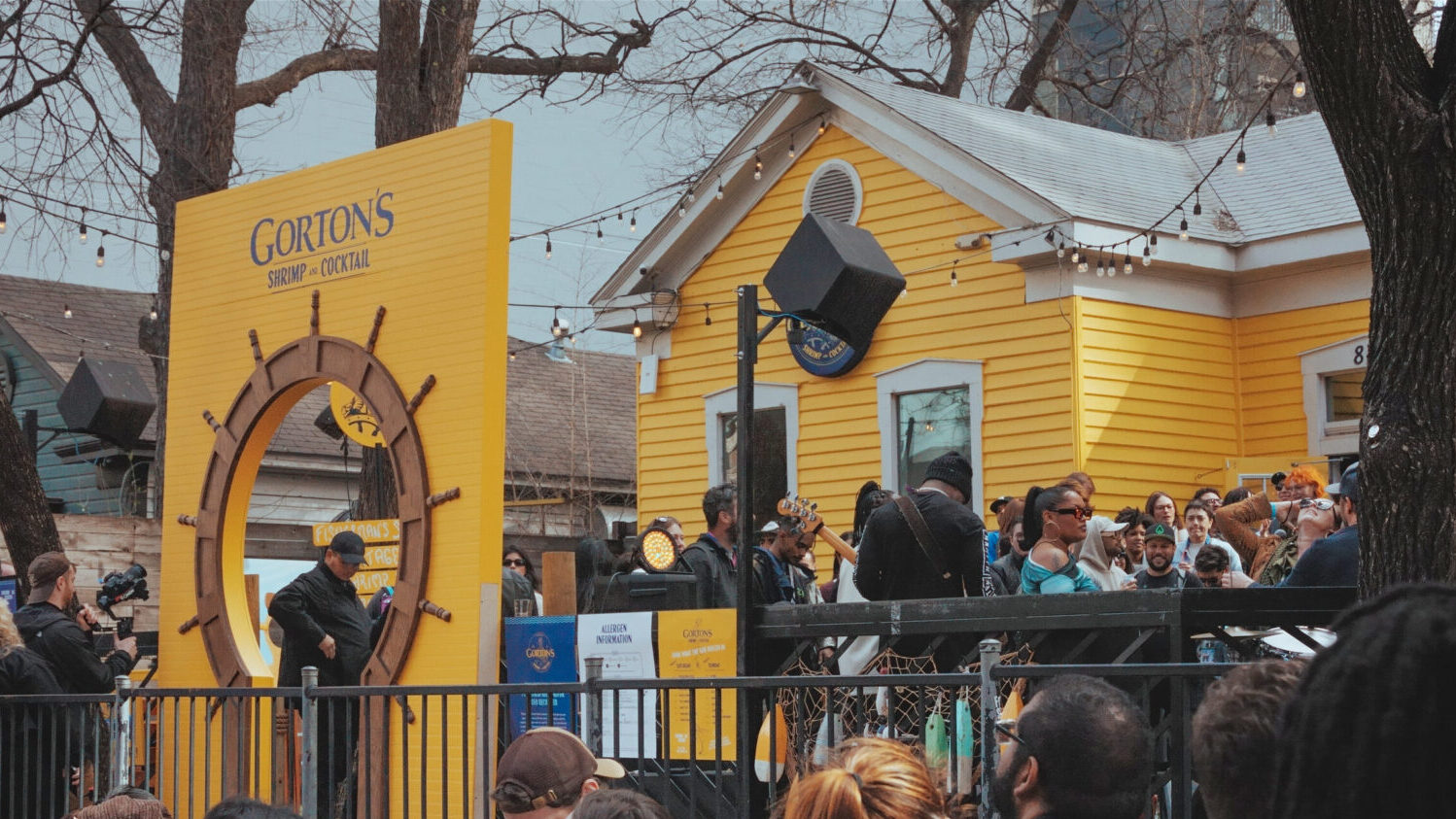
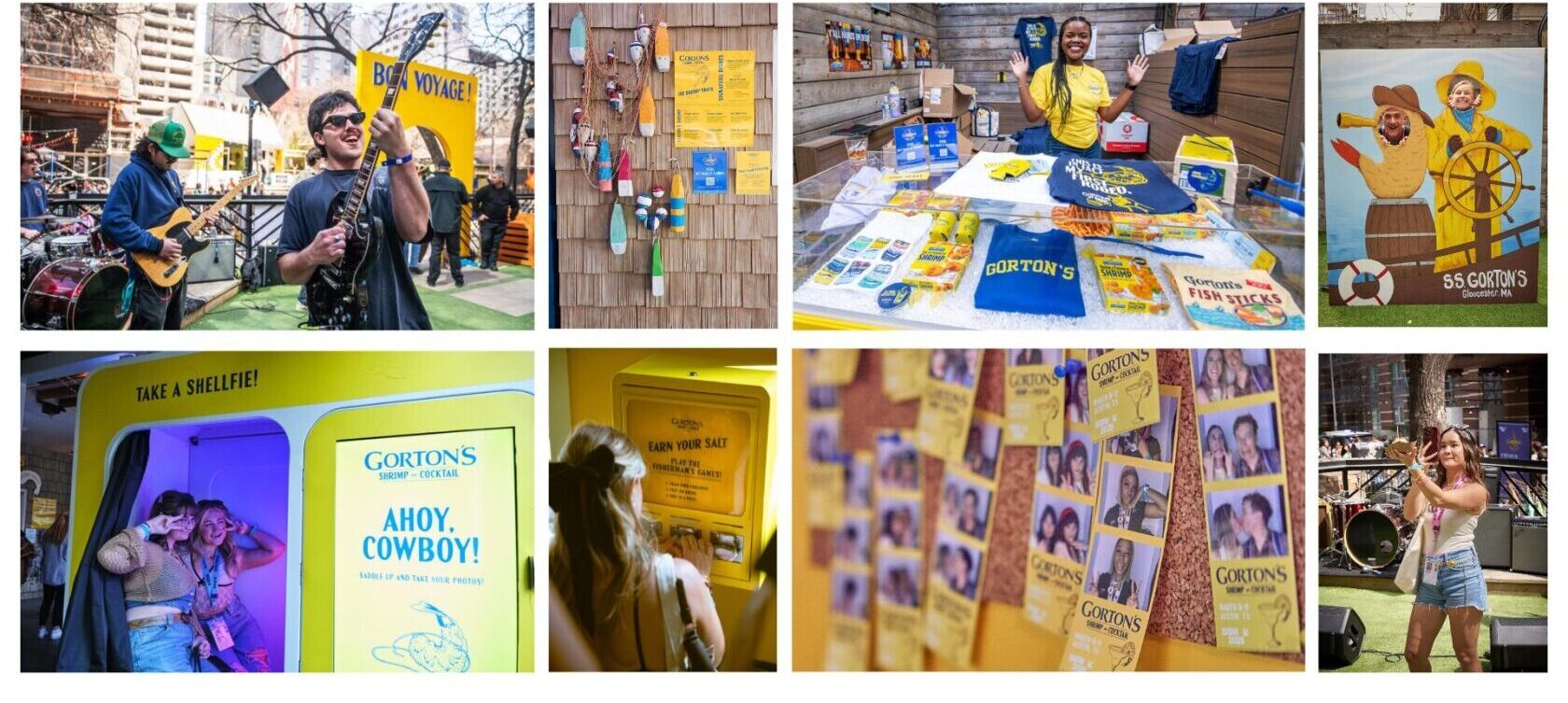
We brought Gorton’s Shrimp & Cocktail to life through a full branded house takeover on Rainey Street, creating an authentic slice of Gloucester infused with Austin’s energy. The home was wrapped in Gorton’s bold and iconic yellow, instantly recognizable from the street, while a massive ship’s wheel archway welcomed guests inside.
The visual design had to be clever and aesthetic enough to surprise our audience, leading to sharing the Gorton’s brand into the world as walking advocates.
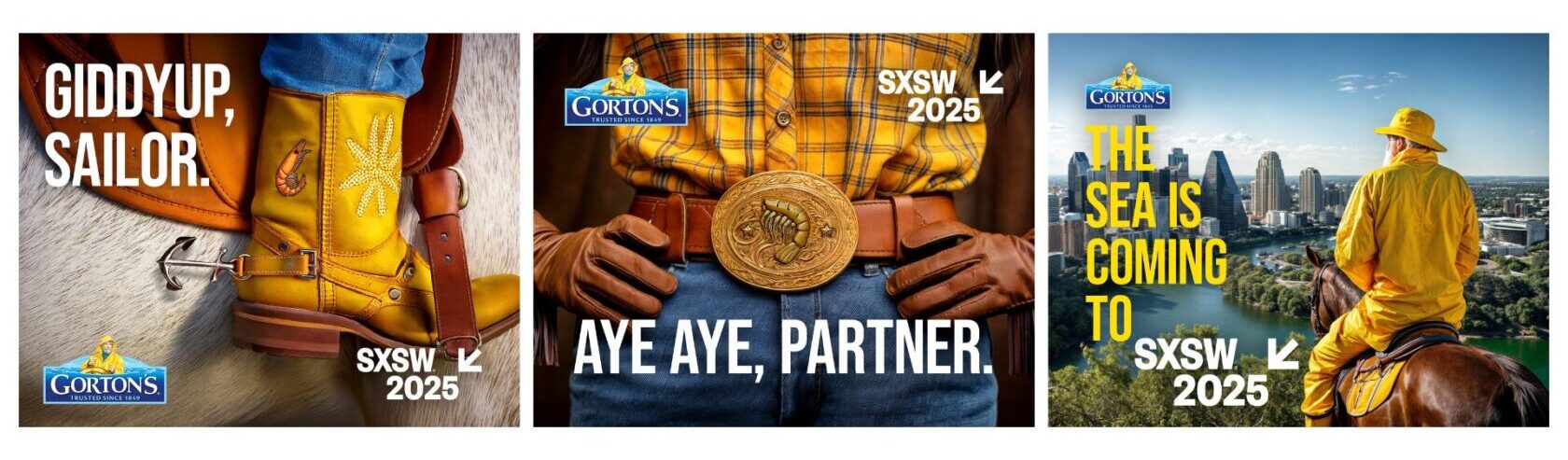
Signage and merch included things like shrimp being lassoed and lines like “Ahoy, cowboy!” and “This is, in fact, my first rodeo.” We carried the theme through every last detail, down to the “Buoys” and “Gulls” bathroom signs, and a menu of custom cocktails inspired by the New England brand. (Cape Ann Codder, anyone?)
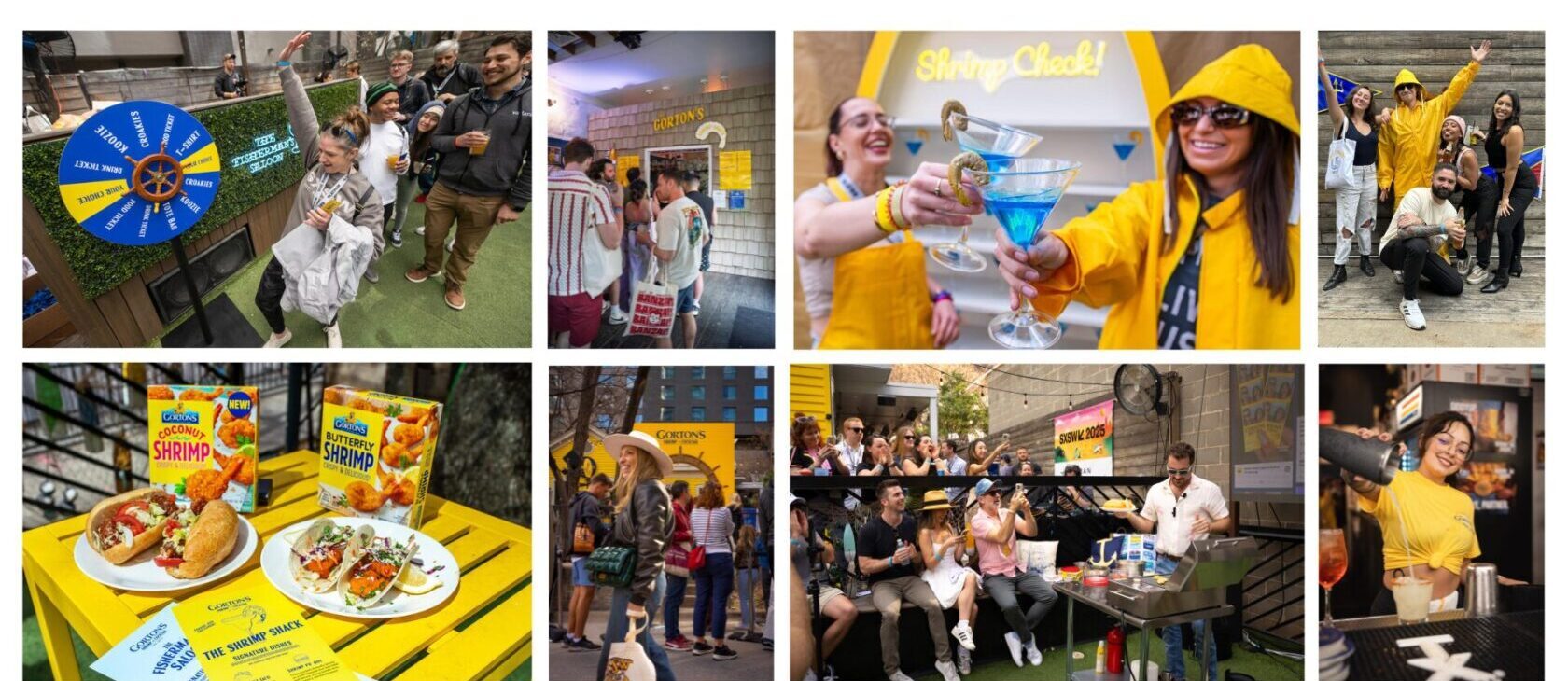
Every element of the event needed to foster that feeling of connection, community, and discovery that we know this younger audience craves. Up and coming bands played throughout the day in the front yard. Our Shrimp Shack served tacos, sliders, and shrimp samples paired with custom cocktails, while daily live cooking demonstrations from popular influencer @theShaySpence showcased how simple and modern the product could be. Each room offered a unique interactive moment. An analog photobooth encouraged guests to pin photos to the wall to create a living mosaic of the diverse community who experience the brand. A hands-on activity dispenser sparked spontaneous interaction between guests.
When an experience creates surprise, warmth, or connection, it stops being marketing and starts becoming a memory.
We had a line down the block all day, both days of the event. Beyond Texas we had millions of social impressions before, during, and after the event. Attendees didn’t just share content. They endorsed the brand, signaling to their own communities that Gorton’s is full of unexpected possibilities.
This was more than a branded activation. It was a cultural moment and a powerful step forward for a brand ready to evolve. We transformed a brand once seen as predictable and outdated to one that shows up in surprising and culturally relevant ways, on people’s plates and in their lives.
That’s what it means to move souls in order to move feet.
If AI Is the Answer, What Was the Question?
Michele Hart-Henry, Managing Director, CP Health
Having recently returned from the annual health technology conference, ViVE, in Los Angeles, I would summarize the atmosphere as expensive and slightly confused.Between the sprawling, multi-space booths and the high-end giveaways, the investment in “the future of health” is staggering.
Yet, walking the floor, I noticed a curious paradox: for all the capital being poured into the room, many players struggled to articulate exactly what they do for the people at the center of the ecosystem, or why they do it.
AI was, predictably, the oxygen of the conference. It was everywhere. But as I sat through sessions and navigated the show floor, it became clear to me that we are in danger of building a very expensive, sophisticated house without ever asking the residents who will live in it what they need.
We are obsessed with how to solve healthcare’s problems with AI, but I’m not sure which of healthcare’s myriad problems we’re addressing. At the same time, I fear we’re neglecting the who and the why.
Are we reducing stress and burnout in clinicians? Are we making it easier for health systems to accurately bill payers, or to plan for capacity issues? Are we making it less expensive to answer routine questions and phone inquiries? Are we making it quicker to find clinical trials? Are we connecting home devices to remote patient monitoring tools? The answer to all of these questions, and many others like them, is yes. That’s exactly why all of these companies come to conferences like ViVE or HIMSS.
But why? Why are we doing this? And most importantly, for whom are we doing this? At Connelly Partners, we believe that if you start with humans at the center, their fears, their language, and their motivations, the technology finds its rightful place as a high-powered assistant.
The Inclusion Gap: About Them, Not With Them
One of my biggest takeaways from the week is that AI is currently being built in a vacuum. Most Large Language Models (LLMs) are trained on data written by clinicians and researchers. While that’s great for clinical accuracy, it creates a language divide. Clinicians and patients don’t speak the same language, nor do they share the same priorities.
We see this in the development process: too much AI is being created about the patient, but not with the patient. If we don’t include the consumer in the co-creation process, we risk building “solutions” that are technically brilliant but practically alienating. For example, ambient transcription is a godsend for reducing clinician burnout, and we should celebrate that, but are we sharing those insights with the patient? Are we using that technology to help the patient see the “whole picture” of their own health, or is it just another way to automate a back-office task?
The Data Silo Problem (Again)
It’s 2026, and we’re still talking about interoperability. Even within the same platforms, the mountains of data we’re collecting don’t always talk to each other.
More importantly, we are ignoring a goldmine of unstructured data. Patient-supplied notes, journals, and lived-experience observations often stay outside the system. Yet this “subjective” data is often the most vital context for healthcare, helping people live their most fulfilled lives. If AI can’t digest the patient’s voice alongside the clinician’s expertise, it isn’t really “intelligent.” It’s just a fast filing cabinet.
At the conference, I observed three divergent tracks of AI:
The Enterprise Track: Tools built for and by health systems to streamline operations, which were much more prevalent.
The Clinician Track: Tools intended to make it easier for practitioners to do their jobs while reducing administrative burden.
The Consumer Track: Tools patients use independently to increase their health literacy, the builders of which were clustered among the startups at the fringe aisles of the larger players.
The concerning point? These worlds aren’t harmonized. Dr. Google is dead; long live Dr. AI. Consumers are already using conversational AI as their first entry point into the health journey. They are turning to AI “companions” to explain their labs or symptoms before they ever call a doctor, or to translate what a doctor told them. If the healthcare system doesn’t keep up and find a way to bridge these tracks, the gap between “system-speak,” “clinician-speak,” and “patient-reality” will only widen.
Moving Toward “More Birthdays”
It wasn’t all tech for tech’s sake, though. There were moments of genuine clarity that reminded me why we do this work.
City of Hope, for example, shared how they are using AI to bring clinical trial opportunities directly to the bedside. By giving doctors the ability to find and recommend trials in the moment, they aren’t just “optimizing a workflow”—they are living up to their mission of providing “More Birthdays.”
The Architecture of Care: Tool vs. Foundation
It feels as though we are treating AI as if it is the healthcare system, when in reality, it should simply be the scaffolding that allows ALL humans in the system to function better. When we prioritize the “How” (the algorithm) over the “Who” (the patient and practitioner) and the “Why” (the outcome), we build a system that is technically efficient but emotionally bankrupt.
My take on all of this is simple: Technology should make the invisible visible. It should capture the patient’s whispered concerns in unstructured data, bridge the literacy gap between clinician-speak and care-delivery-reality, and automate the mundane so that the human connection can flourish.
More AI isn’t the answer. Thoughtfully designed, co-created tools are. AI should be used to eliminate the friction faced by ALL humans when navigating and operating in the healthcare world. Not just patients. Not just doctors. All humans. And as such, all humans (not just those charged with lowering costs) should be part of the discussion that identifies where the friction is and how AI can help.
After all, the most expensive booth in the world can’t buy the trust that comes from finally feeling seen, heard, and understood. That isn’t a tech problem; it’s a human one.
SOUL MOVERS: Episode 1: Debo Ray
In an age defined by algorithms and automation, there’s still one thing no machine can replicate: the power to move the human soul.
Soul Movers is a series of short films that explores that rare, electric force behind the people who move us. From Grammy-nominated vocalists and famous chefs to magicians, dancers, and speechwriters, these are the humans who remind us what it means to feel something real.
Each film explores what defines us at Connelly Partners, and our core belief: If you want to move customers’ feet, you have to first move their souls.
From Consultant to Believer: How Connelly Partners Changed My Mind About Integration
Will Burns, Chief Growth Officer
For most of my career, I’ve been inside or alongside ad agencies of every shape and size. I’ve worked within them, led them, pitched for them, and in recent years, consulted with them — often on their approach to new business. And if there’s one claim I’ve heard more than any other, it’s this one: “We’re a full-service agency, all under one roof.”
Every agency says it. Every deck, every website, every pitch. And every time, it’s not quite true.
The “Full-Service” Myth
Even the most talented 20-person shops I’ve consulted with confidently call themselves full service, usually because they’ve built a tight core team and then outsource what they need when they need it. It’s not deceitful — it’s just how the industry evolved. You find great specialists, build relationships, and assemble capabilities to meet the client’s needs.
But to say it’s all under one roof? It never is. Not really.
That was my baseline assumption—until I met Connelly Partners.
How It Started
What began as a consulting engagement quickly turned into something else. My task was to immerse myself in the Connelly Partners business: understand how they see themselves, how they sell, how they deliver.
I went deep. Ten senior employee interviews. Five recent pitches. Five RFP responses. Countless hours on their site and blog. I wanted to see what made this place tick.
And somewhere along the way, a realization hit me: this wasn’t another agency claiming integration. This was the first agency I’ve seen that actually is integrated.
No Assembly Required
Connelly Partners is the rare agency that truly lives up to that “full service” claim. Advertising, brand strategy, media planning and buying, digital, influencer marketing, production, even in-house editing — all actually under one roof (well, several roofs, given our teams in Boston and Dublin).
When that hit me, so did the client benefit.
For the past decade, marketers have been assembling ecosystems of “specialist” agencies — one for social, one for influencer, one for digital, another for media. On paper, it sounds smart: best-in-breed expertise across every channel.
In practice, it’s chaos. Every specialist brings a narrow view of the brand and, understandably, an agenda to sell more of their niche. So the marketer becomes the integrator — trying to align competing priorities, maintain brand consistency, and assemble a unified plan out of mismatched parts.
It’s exhausting.
At CP, that problem doesn’t exist. No assembly required.
One agency. One brand understanding. One cohesive plan. We can shift strategy on a Tuesday and deploy a new mix on Wednesday. Because when all the disciplines live together, collaboration isn’t a talking point — it’s just how work happens.
The Soul of the Agency
Of course, great structure means nothing without great spirit. What drew me in even more than CP’s integration was its ethos: We move customers’ feet by first moving their souls.
That line hit me because it’s not just a brand statement — it’s a truth. Everything here is guided by empathy, curiosity, and creativity that’s designed to drive real business outcomes. Emotional intelligence meets commercial intelligence. And it works.
From Consultant to CGO
My time consulting with CP’s leadership team went better than either of us expected. We clicked — philosophically, strategically, culturally. I saw an agency with enormous potential. A true full-service shop that nobody was giving full credit to.
So when the opportunity came to join as a fractional Chief Growth Officer, the decision was easy. My job now is to make sure marketers discover what I’ve discovered — that Connelly Partners is the real thing.
No assembly required.
CP’s Super Bowl LX Highlights
While the Seahawks and Patriots fought for the Lombardi Trophy at Levi’s Stadium on Sunday, a different kind of high-stakes competition was playing out across the commercial breaks. Our team sat down to analyze the strategies that broke through the noise, evaluating the hits, the misses, and the head-scratchers. Between the heavy lean on 90s nostalgia, the swarm of celebrity cameos, and the quantity of AI content, we weighed in on which creative risks actually delivered a return on the most expensive airtime in history.
In a blur of over-the-top, (now to be expected) random celebrity cameos, the ad that stood out to me was “Relax your Tight End” by Novartis. Differentiating and unexpected comedy from a Pharma giant, delivering an instant product-benefit connection without the usual lifestyle formula … all with the contextually relevant power of celebrity. Parody-driven tone and music with hard-hitting stats were perfectly executed. Home run.
Hillary Williams, Director of Brand Leadership
We all knew AI was going to be front and center, and the “Good Will Dunkin’” spot was a great example of how AI can really bring an idea to life. It was a little creepy, sure, but still a fun concept. Nostalgia was everywhere too, and the VW spot bringing back the still-strong “Drivers Wanted” tagline was beautifully done. I’ve always had a soft spot for VW ads, so that one really stood out to me. But my favorite of the night was the Redfin Rocket Mortgage ad. It hit that sweet spot of great storytelling, a stunning Lady Gaga track, and a message that really sticks with you — one we could all use a reminder of. Finally, the spots for Claude were brilliant. They made me excited that concept is still king.
Alyssa Toro, Sr. Partner, Chief Creative Officer
My personal MVP was Emma Stone for Squarespace (the cinematography alone!), but I was struck by two overall themes: low-fi nostalgia (Crypto.com and Dunkin) and a push for love, peace, and being a good person. In a world wrought with turmoil, many brands turned to happier moments (Redfin, Lays). As Bad Bunny famously says, “The only thing more powerful than hate, is love.”
Miranda Gaudet, New Business Director
As someone who placed an ad this year, I have to admit that I watched the game with a different lens, knowing the perils of ad logs in a live, cultural event! So you could say my attention was certainly heightened ;). I thought Anthropic did a great job coming out swinging on ads in ChatGPT, and for those of us who use AI, they really hit the nail on the head in personifying what that experience could be like. I feel like campy nostalgia seemed to be on display, and while Dunkin’ kind of nailed it, Instacart did not, despite great celebrity talent. And while I realize this is unpopular and people are fed up with Coinbase, but seriously, we all sang along, right? And stayed and waited to see where it was going?
Michelle Capasso, Partner, Chief Media Officer
A lot of brands continue to play with nostalgia and tapping into the 90s, but I was specifically dialed in on the Xfinity Jurassic Park ad. The set up was classic to the film, but the relief that Xfinity brought to the scenario, and imagining what would have happened if the park had a more stable connection was perfect. It was a great example of a simple solution that a brand can articulate over and over again. Plus, it was fun too! Xfinity has been on a great run with their Super Bowl commercials over the past several years (remember Beyonce seeing if she could break the internet?). They continue to showcase the same strategy – Xfinity offers a strong connection – and have found a number of hyper relevant ways to show up, referencing current events, cultural icons, and more in order to excel in their creative showing.
Allyson Chapman, Associate Strategy Director
I loved the simplicity of the Levi’s spot; it was a perfect, visual tribute to the brand’s history that didn’t need bells and whistles to be effective. The Uber Eats ad with Matthew McConaughey and Bradley Cooper also stood out to me, because it got out of its own way with the script. Letting Matthew McConaughey ad-lib and play to his strengths created genuinely funny moments that didn’t feel forced.
JoAnne Borselli, Group Brand Director
This year’s Super Bowl ads proved that celebrity cameos can’t rescue a weak concept. The Dunkin’ spot was the ultimate flop—a cluttered “advertising fever dream” that chose a celebrity bingo card over a clear idea. The most impactful moments skipped the glitz for raw emotion. By overlaying iconic sports speeches onto the stories of patients, these ads successfully translated grit and spirit into a real-world context.
Barry Frechette, Director of Production
Lay’s “Last Harvest” stood out as Sunday’s emotional peak, hitting all the feels by highlighting the vital role of family farms. On the comedy front, William Shatner’s “Will Shat” double entendre for Raisin Bran took the crown—a hilarious, “if you know, you know” nod to the importance of fiber. Nostalgia was easily captured by the “Good Will Dunkin” throwback, while the influx of AI commercials felt like the worst of the bunch.
Michele Hart-Henry, Managing Director, CP Health
This year’s winning ads leaned into a unifying theme of legacy, from the nostalgia of “Good Will Dunkin,” Levi’s iconic back pocket, and the Budweiser Clydesdales to modern spins like VW’s “Drivers Wanted” and our own Gorton’s Seafood spot. These commercials were universal hits in my family’s multi-generational group chat, though each age group—from the Silent Generation to Gen Z—interpreted “legacy” differently. Whether seen as vintage style, brand relevance, or pure sentimentality, it was a reminder that legacy isn’t just about history.
Carrie Parks, Managing Director
Novartis took the top spot with their “Relax Your Tight End” ad, succeeding through a simple concept, relevant stars, and light-hearted humor that avoided the typical Super Bowl trap of over-complicating the message. On the other hand, ai.com was the night’s clear loser; their spot lacked substance and failed to offer a clear consumer benefit. Adding to the failure, their domain crashed immediately after the ad aired, signaling a lack of technical readiness.
The winner in the ai category was Anguilla; with .ai domain sales already driving millions in revenue, the British Territory is the true beneficiary of the night’s AI-heavy messaging. Congratulations, Anguilla—you’re the real winner of Super Bowl 60.
John Norwood, Associate Brand Director
This year’s broadcast confirmed that the most effective breakthrough strategies remain rooted in the familiar pillars of humor, nostalgia, and celebrity influence. The most successful brands used these elements to create an immediate connection with the viewer, bypassing the need for complex explanations. By blending star power with ‘throwback’ cultural beats, advertisers were able to create a sense of instant trust and emotional resonance that a new concept alone rarely achieves.
Scott Madden, Sr. Partner, Chief Strategy Officer
Despite being a marketer who believes strongly in the power of brand storytelling, I have to admit that when I’m off the clock and sitting on my couch as a consumer, you can pull me in very easily with relatable humor and funny one-liners. I’m a cheap laugh, what can I say. So naturally I found myself enjoying a bunch of the comedic ads—a few that come to mind are State Farm’s “Stop Livin’ on a Prayer” with Danny McBride and Keegan-Michael Key and the nostalgia-focused “Good Will Dunkin” featuring some of my childhood favs.
But if I were to put my work hat back on, I personally loved Grubhub’s “The Feest.” These days people order food delivery like they breathe air, and one of the primary pain points that everyone talks about is all the extra fees. Grubhub creatively—yet very clearly—addressed that topic head-on, conveying a simple message that we can all get behind: no more fees (on orders of $50 or more…there always has to be a caveat, of course). The filming style, the dialogue, the little details (like calling it a “Feest”), and the George Clooney reveal all came together to make a really effective ad that raises awareness of something—no fees—that will resonate with the masses.
Neal Malone, Director of Social Media, Influencer Marketing, and PR
At the end of the day, the best ads are the ones that keep the conversation going long after the final whistle. Whether it was a nostalgic throwback or a glimpse into the future of AI, this year’s lineup proved that a $10 million-dollar buy is only as good as the idea behind it. The game may be over, but the debate over who truly won the night is just beginning.
Lessons from Failed New Year’s Resolutions
Scott Madden, Sr. Partner & Chief Strategy Officer
Like many, as I work from home this week, I’m also forming my short-list of resolutions for 2026. Some, like Dryuary and a daily Peloton ride, feel doomed from the get-go (they certainly do for me). After all, only 6% of all resolutions started on Jan. 1 are maintained all year. Even more profound, the majority of us break our resolutions by the 2nd Friday of January. But there’s an important lesson we can learn as strategists from these epic fails that may hold the secret to better campaign results in the New Year.
I’ll start by telling you what you already know: all audiences today are full-fledged members of the attention deficit society. And accordingly, we all bounce, or rather thumb, from one shiny thing on our screens to the next. Most of us don’t retain information in our heads as well as we did five years ago (Quick: Name the streamed series you watched just before the last series you watched? Can’t do it, can you?), and we certainly don’t focus throughout our day as we did before the era of reels, shorts, pings, and notifications set off Busy Brain Syndrome.
Behavior science tells us that most resolutions are bound to fail because they tend to be radical (all-in) and immediate (Jan. 1) changes in our common behavior, rather than more modest and gradual shifts. Most humans successfully enact change when the transformation is gradual and includes new elements. I’m not professing nudge theory here. I don’t believe that a linear series of nudges works in most situations, especially when you factor in Busy Brain. But as I think about what derails my resolutions year after year, I have come to realize that it’s more the ADD at work than it is my inability to find inner strength to see them through. And that’s where the lesson lies.
We all start with a specific motivation when it comes to acting on a resolution. “I want to be in better shape,” “I want to get into my favorite bathing suit and feel comfortable in it,” “I want to swear less and be more patient,”….(two of the three are mine BTW, feel free to guess which). But with Busy Brain, that one motivation can be forgotten or deemed less inspiring as quickly as the name of last month’s streamed series.
The lesson I’m proposing is that audiences today need multiple motivations to get them to take an action we want them to take. Think of it as a series of micro motivations that you lean into when crafting message strategy; they should be a mix of emotional and functional. Above all they should be multiple, each addressing a defined micro motivation. “I want to feel confident” is an emotional micro motivation. “I want to have more muscle definition” is a related, but functional micro motivation. “I want to have more energy at the end of my day, to be more fun with my spouse,” yet another.
When we embrace the idea that a series of distinct micro motivations, when well defined, should be seeded across multiple message strategies throughout all of our content, we give our audiences more ‘sparks’ to drive desired actions and in doing so, lower the risk of them becoming less shiny or forgotten. And each of those sparks will likely work more effectively at different moments in time given the headspace of our audience when our content reaches them. Analytics will help us recognize which micro motivations work best where and when and optimize accordingly. And that, my friends, is how you make campaigns perform better in the new year.
Wishing everyone a happy and prosperous 2026!
2026 Social & Influencer Predictions
Neal Malone, Director of Social Media, Influencer Marketing, and PR
AI Resistance, Creator Rates, and Performance Marketing
Asking a social media or influencer marketing executive for 2026 industry predictions is like asking a meteorologist what the weather is going to be like next month. They’ll give you their best guess, but when it comes down to it, we could get a massive snowstorm or a series of unseasonably warm days.
Like any good meteorologist, though, we never shy away from a prediction—even if the industry landscape is moving at the speed of a Nor’easter. Here are four social media and influencer marketing thoughts we have going into the new year:
1. Social media will be a very unwelcoming place for AI
As AI continues to flourish across industries, it’s going to be met with significant resistance on social media. It’s so easy to get swept up in all the ways AI is transforming our world—and in many cases that’s true. But in case you haven’t noticed, social media is quickly becoming a place where anything that even might be AI-generated is deemed “slop” and gets rejected immediately.
Here’s the thing—you can adopt AI in many facets of life while still rejecting it in others. It’s a great collaborator and productivity generator, but it’s just not what people (especially Gen Z) want to see in their feed. So in 2026, get ready for social media to be a safe haven for everyone looking for good ol’ fashioned authenticity and humanity.
2. Creator content will become paid social fuel
Remember when you could reach large audiences with organic content? Ahhh, those were the days. Fast-forward to today and the platform algorithms have made organic reach almost impossible to predict. Concerning? Maybe. But a more optimistic take is that it’s simply changing how brands should be viewing creator partnerships.
Partnering with creators used to be about renting access to their followers, but now that you’re only reaching a fraction of their audience organically, brands should instead be viewing creator partnerships as content generators for their paid social campaigns. There’s still a ton of value in brand messaging coming from a trusted third-party voice as opposed to a logo. It’s just that your content now requires a little boost.
The changing landscape means that the connection between creator content and performance marketing is as strong as ever. Brands should be treating authentic, creator-generated content not just as one-off organic posts, but as perpetual assets that can be tested, optimized, and scaled across paid social platforms. You’re going to see more and more brands moving beyond traditional ad formats and instead powering their entire paid social strategy with content that carries the undeniable trust and authentic voice of a creator.
3. The bubble might finally burst for creator rates
Anyone who works in influencer marketing knows firsthand how much time and effort goes into each brand partnership—both on the creator and agency/brand side. It takes immense talent and creativity to do what creators do, and that shouldn’t be overlooked.
But with organic reach way down and paid amplification almost essential to get the eyeballs you’re looking for, the climbing rates are becoming much harder to justify. For a while now, the inflationary environment around rates has seemed unsustainable, and in 2026, we may see brands finally say “enough is enough, we’ll go find someone else.”
4. The line between social content and TV will only get blurrier
When you sit down to watch your favorite TV show these days, it’s only a matter of time until you see creator-generated content in some form or fashion. Maybe it’s a brand spot powered by creator content or a social video running as a standalone ad. Either way, you’re seeing the social sphere blend into the traditional media world.
The feeling is mutual, too. Creators are searching for new ways to entertain their audiences, and that means turning their social channels into….well, TV. Episodic content, short films, live events, and reality programming are all extremely popular among creators. Call it blurred lines, call it mutual admiration—you just see a lot of one when you’re watching the other. This trend will only become more obvious in 2026.
From the Source: Key Insights from Our Interns
Connelly Partners’ Fall ’25 Intern Class
The close of the Fall Semester brings us a chance to celebrate the fresh energy, sharp insights, and dedication of our intern class. They have spent the past few months deeply involved in the fast-paced world of advertising, contributing across Strategy, Creative, Brand, Data & Analytics, and Education. Here are their key takeaways and favorite moments from their time at Connelly Partners.
Refined Instincts and New Perspectives
Maggie Chambliss, Strategy
Working at Connelly Partners as a Strategy Intern taught me how to refine my instincts for pulling consumer insights and gave me hands-on experience with a variety of brands. Coming from a psychology background, I learned how to leverage my education in human behavior as an advantage that brings new perspectives to the table. I gained a deeper understanding of brand strategy during this internship simply by learning from the best: the CP Strategy Department. My experience working with this team was the highlight of my time at CP because they provided mentorship, valuable advice, and lots of fun. I’m incredibly grateful for a team you can learn a lot from and also laugh with simultaneously.
The Value of Immersion
Sophia Emile, Brand
During my time at Connelly Partners, I’ve had the chance to explore a wide range of disciplines and grow significantly as an emerging professional. From contributing to New Business initiatives to supporting thought leadership with clients, every experience and conversation has been truly rewarding. Working alongside passionate interns and talented employees across teams has been incredibly eye-opening and inspiring. What I’ve valued most is how much I’ve grown; skills that once felt challenging in my first month now feel natural and intuitive.
The Whole Agency View
Maggie Murray, Education Intern
My Connelly Partners Education internship was a deep dive into the fast-paced world of advertising. From day one, I received hands-on experience, engaging in both internal support and direct client interaction. I honed my management and communication skills by serving as a client liaison, responsible for setting up project meetings and ensuring a smooth flow of information. A core part of my role involved strategic research, where I contributed to several value-add projects that directly informed our clients’ ongoing strategies. Ultimately, the highlight of the experience was the unparalleled opportunity for cross-functional collaboration. By supporting and working alongside every department, I gained a holistic understanding of the Agency’s operations and built an internal network—which was my favorite and most rewarding part of my time at CP.
Strategic Writing in Action
Kenna Lloyd, Copywriting
I have learned so much during my time at Connelly Partners. On the work side, I got real experience with what a copywriter actually does! I wrote for some of our largest clients and worked across headlines, radio, scripts, and digital—which was an incredible range. I joined brainstorms and early concepting, and saw firsthand how strategic writing shapes those initial ideas. Working with the Creative Team here has been the best; it was a great place to learn, and I’m genuinely grateful for everyone I got to work with!
Expanding Technical Horizons
Rheona Mehta, Data and Analytics
My time at CP has been incredibly exciting. I feel so lucky to be part of such a welcoming and immersive environment. From day one, I was encouraged to challenge myself and try new things with the amazing guidance of the Analytics team. I began my time at CP working on reporting and client-facing data work, areas I had similar work experiences in. In my second term as an intern, I had the opportunity to expand my technical skills and shift my focus toward data engineering. Having such a diverse and supportive experience at Connelly Partners is just one of the many reasons why I value my time here and the people who have helped shape my experience.
Looking Ahead
As they complete their semester, our interns leave behind a legacy of enthusiasm and valuable contributions. Their reflections truly capture the spirit of our agency—a place where professional development, cross-functional teamwork, and fun are all part of the daily grind. We are immensely proud of everything they have accomplished and look forward to what’s next for this talented group!
Join our mailing list
Manage Consent
To provide the best experiences, we use technologies like cookies to store and/or access device information. Consenting to these technologies will allow us to process data such as browsing behavior or unique IDs on this site. Not consenting, or withdrawing consent, may adversely affect certain features and functions.
Functional
Always active
The technical storage or access is strictly necessary for the legitimate purpose of enabling the use of a specific service explicitly requested by the subscriber or user, or for the sole purpose of carrying out the transmission of a communication over an electronic communications network.
Preferences
The technical storage or access is necessary for the legitimate purpose of storing preferences that are not requested by the subscriber or user.
Statistics
The technical storage or access that is used exclusively for statistical purposes.The technical storage or access that is used exclusively for anonymous statistical purposes. Without a subpoena, voluntary compliance on the part of your Internet Service Provider, or additional records from a third party, information stored or retrieved for this purpose alone cannot usually be used to identify you.
Marketing
The technical storage or access is required to create user profiles to send advertising, or to track the user on a website or across several websites for similar marketing purposes.
To provide the best experiences, we use technologies like cookies to store and/or access device information. Consenting to these technologies will allow us to process data such as browsing behavior or unique IDs on this site. Not consenting or withdrawing consent, may adversely affect certain features and functions.
Functional
Always active
The technical storage or access is strictly necessary for the legitimate purpose of enabling the use of a specific service explicitly requested by the subscriber or user, or for the sole purpose of carrying out the transmission of a communication over an electronic communications network.
Preferences
The technical storage or access is necessary for the legitimate purpose of storing preferences that are not requested by the subscriber or user.
Statistics
The technical storage or access that is used exclusively for statistical purposes.The technical storage or access that is used exclusively for anonymous statistical purposes. Without a subpoena, voluntary compliance on the part of your Internet Service Provider, or additional records from a third party, information stored or retrieved for this purpose alone cannot usually be used to identify you.
Marketing
The technical storage or access is required to create user profiles to send advertising, or to track the user on a website or across several websites for similar marketing purposes.