We helped Coors to bring The Big Chill to life, sparking an unforgettable energy across Cork and Dublin. These sold-out events featured international DJs, mountain-cold refreshment, and a vibe that truly defined the season.
To announce The Big Chill and set the mood, we crafted a standout OOH special build on Dublin’s Camden Street. We utilized icy-neon lighting and dramatic dry-ice effects to transform the iconic Coors mountains into a full sensory moment. This special build, supported by multiple outdoor and social formats, was the pulse that built major momentum across both cities.
Our team was on the ground at the events, capturing vibrant photo and video content that showcased the pints, the people, and the pure Coors chill. By combining cold refreshment with an unforgettable atmosphere, Coors truly owned the winter season.
Key Takeaways From the 2025 AMA Higher Ed Marketing Symposium: Thriving in a New Era
Gene Begin, Managing Director, CP Education
It was another amazing few days at the AMA Symposium for the Marketing of Higher Education. This year’s conference brought together more than 1,600 attendees from 49 states (2026, Alaska?), 14 countries, 99 institutions, and 125+ industry partners to tackle the seismic shifts facing our sector.
Besides the amazing community that energizes old and new friendships every year I attend, three central themes became clear for me : fostering creativity to energize high-performing teams, re-centering our focus on student success amid daunting macro industry conditions, and strategically integrating and embracing AI’s role in the college search process.
Fostering Creativity: Connecting the Dots From Noise to Wisdom
Author and podcaster Todd Henry kicked off the first full day of sessions with a keynote focused on creativity, bravery and brilliance. In a world drowning in noise, he walked through his framework for filtering that noise into data, information, knowledge, understanding, and finally wisdom. Throughout this process, he identified creativity as our vital differentiator.
Henry highlighted the famous Steve Jobs quote: “Creativity is just connecting things.” This suggests that creativity is less about a sudden spark of genius and more about the skillful, relentless mixing of a rich, diverse set of life experiences.
To ensure our teams remain prolific, brilliant, and healthy, Todd suggests we need to cultivate a clear creative rhythm. This rhythm can be built on five core elements, which he organizes with the acronym FRESH:
Focus
Relationships
Energy
Stimuli
Hours (time for ideas and creative “back burning”)
Henry argues that by actively managing these five areas, a person can move from being an “accidental creative” (reliant on chance) to a prolific, brilliant, and healthy creative professional who can deliver great ideas “on demand.” Consistent creative performance is not about waiting for inspiration, but about establishing a sustainable rhythm and structure around these fundamental daily practices.
Student Success: Our Right to Exist
Higher education is currently navigating significant headwinds. A few mentioned at the conference include:
Economic conditions are impacting student decisions.
Health and wellness are a growing concern for students.
The demand signal is shifting, with the percent of jobs requiring bachelor degrees declining, according to data from Indeed.
We’re facing a perception crisis: two-thirds of Gen Z audiences do not feel they need a degree, and 51% of them who went to college think it was a waste of time and money.
Amidst undeniable macro-level challenges, it was refreshing to hear that the ultimate anchor for all of us in higher education is student success. Ted Mitchell of ACE articulated this perfectly during the panel of higher ed organizational leaders: “Student success is the one thing we can all do. It provides higher ed the right to do what it does.”
Fighting against these headwinds can seem overwhelming. Yet. If you center why we do what we do on the success of each individual student, current and future, we become grounded and able to focus on the immediate impact we can have in this moment.
The AI Revolution in College Search
The most dramatic shift is the increasing role of AI in the college search process. A survey conducted by U.S. News & World Report of 1,600 high school, college, and graduate students shows that students are actively integrating AI into their research:
12% of students are using AI Chatbots for their college research.
More than 50% of high school students reported that AI agents were important for comparing schools.
Students use AI comparisons for critical factors like: basic college stats, costs, academic programs, debt and financial aid, and graduation rate.
Only about 10% are using AI for college application development.
Furthermore, the ways Gen Z consumes information are changing. Speaker Vanessa Lea Otero from Ad Fontes Media shared that more than 50% of Gen Z get their news from “news influencers.” The data on traditional search methods also shows how much is evolving in both online search and traditional referral methods.
Use of Google in the college search process is down from 71% to 64%.
Social search is increasing: Instagram is now tied with YouTube at 17% use, TikTok is used by 15%, and Reddit by 10%. YouTube experienced a 6% drop year-over-year.
The use of AI is having a significant impact on human touchpoints, causing a huge drop in the number of students meeting with their counselors.
What This Means for Marketers
AI is quickly becoming a trusted initial source for comparative data. This means university website content must be immaculate, transparent, and easy for AI to parse. Content sources feeding AI tools include our website, as well as Reddit, Wikipedia, and trusted 3rd-party sites. We must ensure that the facts and figures AI agents pull from our sites and these trusted partners are accurate, up-to-date and paint the most compelling picture of our institution’s value. Periodic audits of our institutions’ digital footprints must be conducted on a regular cadence.
We also must acknowledge the rise of social channels as essential search tools. This requires a fundamental shift in our marketing strategy to re-assert the value proposition of a college degree in a way that resonates with today’s audience. Developing branded content on social media is crucial but so is using authentic advocate and influencer marketing to be presently available on Instagram, TikTok and YouTube when social searches occur.
Finally, the drop in counselor meetings signals an urgent need to pivot the role of admissions staff. Their focus must shift even more so from transactional information delivery to high-value, relational, and empathetic guidance that AI cannot replicate.
The AMA Symposium has given us a clear mandate: Embrace the change. We must be more creative, more intentional about student success, and more strategic about how we integrate AI into our marketing funnels to meet students where they are.
RIP Generic Stock. Hello CP Luxe.
Nadine Cole, Managing Director, CP West
The era of Happy Family Checking into Hotel and Friends Clinking Glasses is officially over. Generic, overused stock images have dominated hospitality marketing for years—leaving every hotel, resort, and destination looking and feeling the same.
The Authenticity Gap in Hospitality
Today’s traveler is discerning. They crave experiences that feel real, meaningful, and tailored to their interests. They’re not looking for staged smiles—they want to see a story they can picture themselves in.
Yet too often, hotels rely on big-stock libraries. These images are shared across industries—one day a luxury pool photo appears on a resort website, the next on a dentist’s homepage. The result? Your brand loses individuality and your audience tunes out.
CP Luxe: A Shift in Approach
CP Luxe is hospitality-only stock, built to solve this problem. Every image is crafted specifically for hotels, resorts, destinations, and experiences, so your visuals feel exclusive, authentic, and on-brand.
When time or budget doesn’t allow a standalone shoot, CP Luxe is a smart way to add personality, texture, and depth to campaigns. Additional AI services make it easy to scale your visuals while keeping them differentiated and true to your brand’s voice. AI doesn’t replace creativity or strategy—it amplifies them, letting you produce high-quality imagery consistently, without compromising authenticity.
Why It Matters for Your Brand
Exclusivity matters. Authenticity matters. Connection matters. By using visuals that are tailored to your brand—and only your industry—you signal to your audience that you understand them, respect their expectations, and deliver memorable experiences.
The era of generic stock is over. CP Luxe is here to help brands stand out, tell their story, and captivate guests.
Ads of the World: Liberty Bank
Liberty Bank could’ve just made a commercial about their new #1 JD Power ranking in customer satisfaction. Instead, we used it to light up a local baseball field so kids can keep playing long after the sun goes down. Because that’s what it means to be “Community Kind.”
AI Is a Productivity Mandate, but Human EQ and Expertise Are Your Only Unautomatable Edge
Hillary Williams, Director of Brand Leadership
Takeaways From CP’s Women’s Leadership Panel
Last week, we brought two of Boston’s leading minds in AI to CP for an honest conversation about how Language Learning Models (LLMs) are rapidly transforming our world on a day by day basis.
I moderated the discussion with Jen Hansen, CP’s Director of Analytics, and over the past few days, five points have stuck with me.
1. Forget How to Work WITHOUT AI
Jenna shared that if her LLM wasn’t working during a business trip, she would pivot to a completely different task, avoiding computer work altogether. Why? Because doing the work without her LLM assistant would be three times as slow, and the time suck simply wasn’t worth it. AI is no longer a helper, it is a productivity requirement. Jenna working without her LLM would have been like trying to send emails with no internet connection … pointless.
2. The Speed of Evolution Is Terrifying ( … and Exciting)
As part of our prep for the panel, we discussed how answers to each question would have looked different a mere four weeks ago. That’s how fast this space is moving. This mandates an “Always-Beta” mentality and as Lauren tells her team, “every day is your day one.” We can’t afford to wait for formal training. We must build time into our week to play, experiment, and constantly relearn or we’ll be left behind.
3. The New Career Risk Is Stagnation
Stop stressing about AI taking your job. Jenna advises to instead, stress about someone who has embraced AI taking your job. If you aren’t actively digging in, testing new platforms, and refining your prompts, someone else certainly is. Career growth now more than ever depends on your curiosity and adoption, not just your tenure or intelligence.
4. EQ Is Your Most Valuable, Unautomatable Asset
In a world drowning in machine-generated content, humanity, empathy, and emotional intelligence have never been more important. AI handles the volume; we deliver the voice and the soul. Lauren’s advice for recent graduates? Take the time to master the art of connection, learning how to impactfully look someone in the eye and shake their hand.
5. You Must Remain the Master of Your Craft
To use AI successfully, you can’t delegate your entire brain to the machine. You must remain the master of your content and your perspective. As Jenna said, your name is still on whatever goes out the door. The human layer of an effective prompt, editing, questioning, fact-checking, and strategic refinement based on expertise is what transforms a generic AI output into your brilliant, brand-safe piece of communication. The question will be how do current young professionals gain the necessary level of foundational knowledge through “learning by doing” what AI now does for them? This learning gap is one of the biggest challenges in our AI era.
When thinking about how to wrap this post up, I wanted to find a way to synthesize all five takeaways in a concise and meaningful way. I turned to AI and after effectively prompting, editing, fact-checking and refining, here’s where “we” landed:
The greatest lesson from our Women’s Leadership Panel? As AI handles the speed and volume, our human intelligence becomes our most valuable asset. Many thanks to Jenna Switchenko and Lauren Murphy for reminding us that EQ, expertise, and a master’s craft are the unautomatable difference-makers.
How CTV Is Reshaping Full-Funnel Marketing
Samuel Burghardt, Media Planner Nichole Bloise, Media Planner
We recently attended a panel discussion on the evolution of Connected TV (CTV) advertising featuring insights from top talent, including Connelly Partners’ very own Michelle Capasso. The conversation was centered on how CTV has transformed from a “nice to have” channel into a strategic backbone for modern video advertising. Here are our top takeaways from the panel.
The Rise and Impact of CTV in Modern Advertising
CTV has moved away from an “awareness only” myth, to a way of driving meaningful lower-funnel results. With the advent of more advanced multi-touch attribution, advertisers are able to better track how CTV campaigns drive customers to conversion. This evolution has pushed more marketers to consider CTV as a core component of their omni-channel strategies.
Measurement, Targeting, and the Challenge of Frequency
Measurement remains a challenge — incremental reach and frequency management are key KPIs, and understanding the cost per unique viewer is critical. Nielsen’s “Big Data” is providing more stable and accurate measurements, allowing marketers to solve the co-viewing problem by using panel based models assigned to person level demographics. ONE Ads has a solution for frequency and increasing the efficiency of CTV Buys. This allows marketers to see reporting on large frequency fluctuations and react to financial waste of high frequency.
Creative Collaboration and Storytelling on a Bigger Canvas
Creative teams are producing content specifically designed for CTV placements, recognizing that this is an area for storytelling and high impact spots. Customized, context-aware creative helps brands connect meaningfully with audiences during premium content moments and connect with the audience when they are captivated. For brands like USAA, CTV enables deeper audience education, telling membership eligibility stories that drive awareness and conversion.
Looking Ahead: Closing the Gap Between Eyeballs and Ad Spend
Linear is still king, delivering 6x more ad impressions due to lighter ad loads and the prevalence of ad-free tiers, but it’s a broad brush without targeting. It has its place, but CTV is the more surgical support needed to reemphasize your message with your key audiences.
As targeting improves, creative strategies evolve, and measurement becomes more robust, CTV is poised to attract larger budgets. Future innovations could include deeper contextual targeting, digital insertions, and AI-driven creative enhancements, all aimed at delivering personalized and impactful experiences.
Our major takeaway from the panel: CTV has evolved from an experimental channel to a strategic necessity, but the industry still has to work on standardizing measurement, inventory availability, and creative execution.
Hatch Awards: The Most Gold & Silver Awarded Agency in 2025
The Hatch Awards is New England’s premiere creative advertising awards event. Holding company agencies to start-up boutiques, in-house groups, production companies, and design firms, come together once a year to commemorate the best in the industry. This year, Connelly Partners was awarded 27 total accolades across 7 different clients and the most gold and silver level bowls than any other organization represented.
“Everyday, we pour our heart and souls into releasing the absolute strongest creative so the end viewer feels something. Not to pile on awards. But because we know creative that is entertaining, empathetic, unique, resonate, or culturally-relevant, breaks through the noise. Great creative results in business success. Industry awards are a nice byproduct of those efforts.”
-David Onessimo, Creative Director, CP
After more than doubling our results of 4 gold, and 4 silver wins in 2024, we’re proud of our momentum in an industry championing great creative and excited to keep pushing for better into the future.
Communication Arts: Seva Canada Among Winners of Advertising Competition
Seva Canada has been announced as a winner of the Communication Arts Advertising competition. The work is one of 117 projects selected from over 1,200 entries.
Seva Canada delivers life-changing eye care programs to some of the most underserved regions in the world. To drive support, we put the spotlight on the patients themselves, sending cameras to Nepal and Tanzania to be given to those who had just undergone sight-restoring surgery. We asked one simple question: “Now that you can see, what do you love most?” These photographs answer the question for Suk Maya, a 72 year old, and Arush, a seven year old—both of whom had just had their eyesight surgically restored.
We’re excited to announce the launch of our work for 826 Boston, a nonprofit dedicated to supporting young writers through tutoring and publishing. Their Fall Annual Appeal campaign, “Why I Keep Coming Back,” centers on the students, volunteers, and staff who make 826 Boston thrive. A true collaboration, this project leveraged our team’s skills across strategy, copywriting, brand management, and production. We conducted interviews and shot footage to capture the community’s stories, creating the final hero film which will anchor 826 Boston’s upcoming fundraising and effectively capture the spirit of their mission.
CP team members attended 826 Boston’s signature fundraising gala on October 23, where the video was showcased among a room full of 300 donors, friends and community members. The event featured a lively series of 826 Boston student and alumni performances, keynote speakers, an electric fundraising auction, and networking conversations before and after the structured program. The evening also honored Sheena Collier with the Changing the Narrative Award and culminated in a conversation she moderated between author Jasmine Guillory and 826 Boston Youth Literary Advisory Board member Camila.
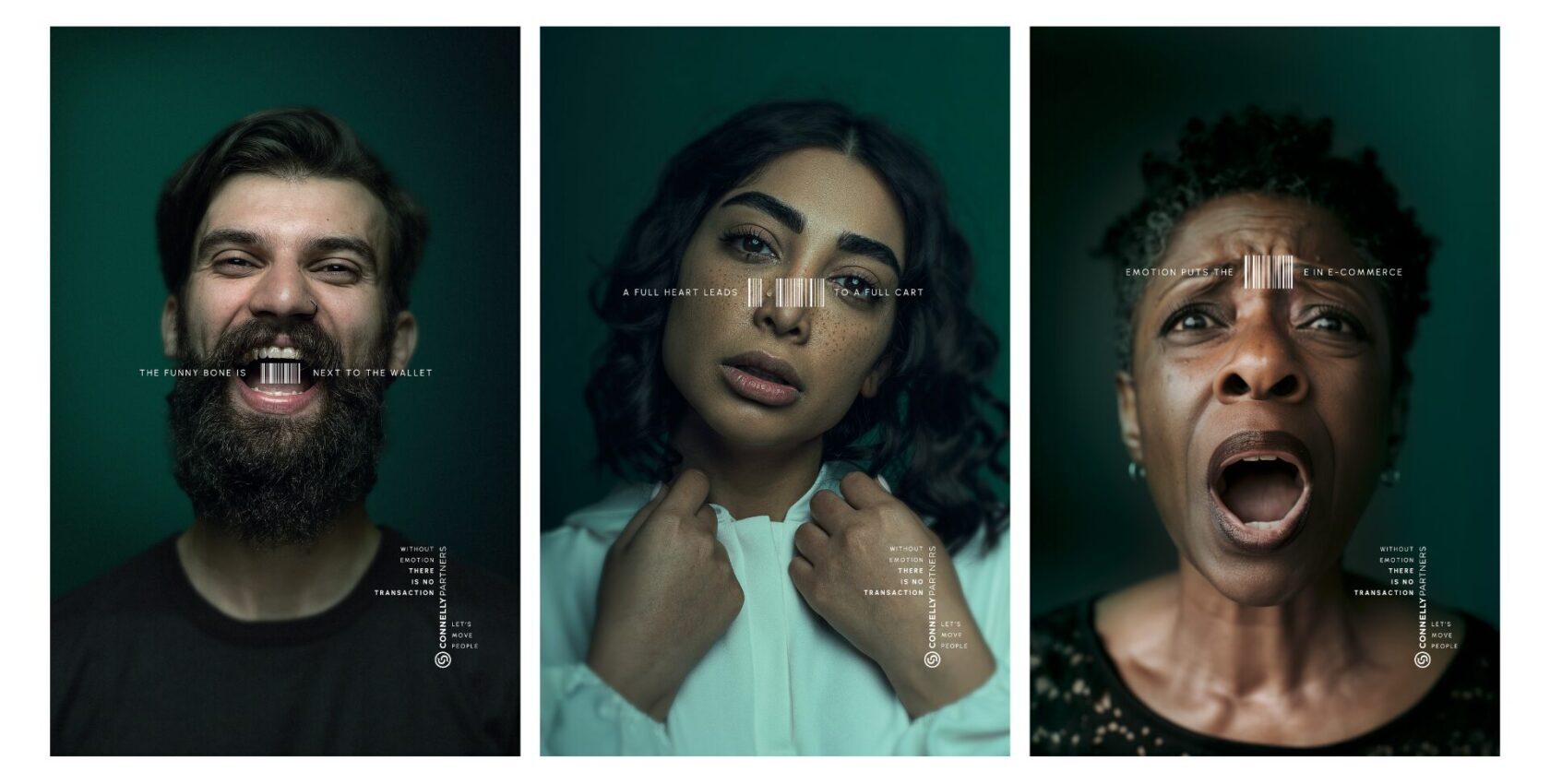
Let’s Move People
Built on a Connelly Partners core belief that emotion drives action, this campaign blends powerful emotional moments with bold, graphic bar graphs to create a compelling visual narrative that proves one simple truth: when people feel something, they’re more likely to act.
Join our mailing list
Manage Consent
To provide the best experiences, we use technologies like cookies to store and/or access device information. Consenting to these technologies will allow us to process data such as browsing behavior or unique IDs on this site. Not consenting, or withdrawing consent, may adversely affect certain features and functions.
Functional
Always active
The technical storage or access is strictly necessary for the legitimate purpose of enabling the use of a specific service explicitly requested by the subscriber or user, or for the sole purpose of carrying out the transmission of a communication over an electronic communications network.
Preferences
The technical storage or access is necessary for the legitimate purpose of storing preferences that are not requested by the subscriber or user.
Statistics
The technical storage or access that is used exclusively for statistical purposes.The technical storage or access that is used exclusively for anonymous statistical purposes. Without a subpoena, voluntary compliance on the part of your Internet Service Provider, or additional records from a third party, information stored or retrieved for this purpose alone cannot usually be used to identify you.
Marketing
The technical storage or access is required to create user profiles to send advertising, or to track the user on a website or across several websites for similar marketing purposes.
To provide the best experiences, we use technologies like cookies to store and/or access device information. Consenting to these technologies will allow us to process data such as browsing behavior or unique IDs on this site. Not consenting or withdrawing consent, may adversely affect certain features and functions.
Functional
Always active
The technical storage or access is strictly necessary for the legitimate purpose of enabling the use of a specific service explicitly requested by the subscriber or user, or for the sole purpose of carrying out the transmission of a communication over an electronic communications network.
Preferences
The technical storage or access is necessary for the legitimate purpose of storing preferences that are not requested by the subscriber or user.
Statistics
The technical storage or access that is used exclusively for statistical purposes.The technical storage or access that is used exclusively for anonymous statistical purposes. Without a subpoena, voluntary compliance on the part of your Internet Service Provider, or additional records from a third party, information stored or retrieved for this purpose alone cannot usually be used to identify you.
Marketing
The technical storage or access is required to create user profiles to send advertising, or to track the user on a website or across several websites for similar marketing purposes.